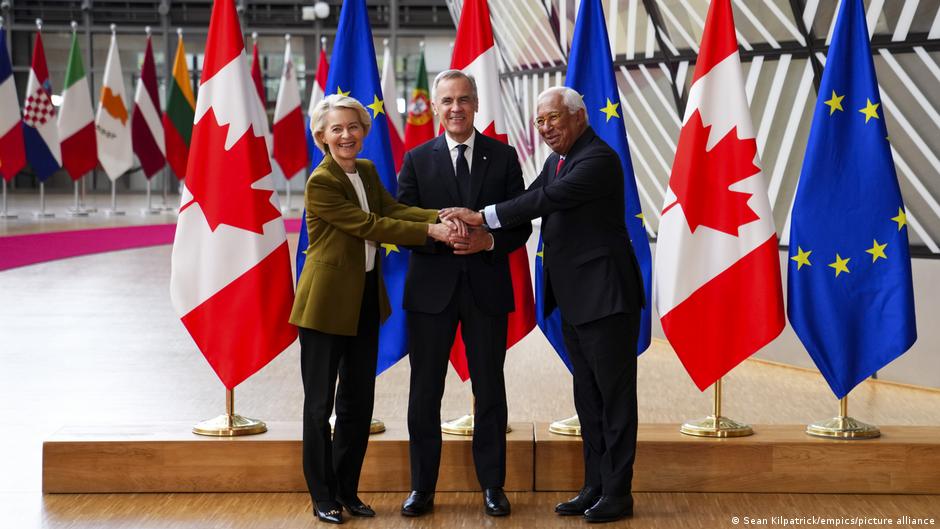
Canadian Prime Minister Mark Carney is seeking to build what he calls a “unique alliance” with the European Union, as Ottawa looks for closer ties with Europe amid worsening trade tensions with the United States. The Wall Street Journal has reported that Canada is considering becoming an “associate member” of the EU, although not pursuing full membership.
European Commission President Ursula von der Leyen signaled openness to a wider partnership during her State of the European Union address in Strasbourg, where Carney was present. She said cooperation could cover advanced manufacturing, technology, defense production, the Arctic, energy, critical minerals, batteries, artificial intelligence, quantum computing, cybersecurity and economic security. Carney is expected to present his vision for future EU-Canada relations in a speech to the European Parliament.
The precise structure of any new arrangement remains unclear. The EU’s relationships with nonmember countries range from free-trade agreements to association agreements and participation in parts of the common market. Patrick Leblond, an international economic relations expert at the University of Ottawa, told DW that Canada was unlikely to adopt European laws or join the EU single market or customs union. Instead, he said, Carney appeared more interested in cooperation on economic security and defense.
Defense is a central part of the discussions. Security analyst Anand Sundar of the European Council on Foreign Relations told DW that Canada currently spends about 70% of its defense budget on US-made equipment and could benefit from greater participation in European projects. Canada has joined the EU’s Security Action for Europe program, which supports joint military procurement, although Canadian companies still face barriers to working with European firms. Sundar said the EU’s willingness to relax those rules would be an important test.
The two sides are also considering cooperation on critical infrastructure, including satellite operations and the maintenance of fiber-optic cables in the North Atlantic, according to Leblond. Canada’s energy resources could also help meet European demand, while closer collaboration could reduce reliance on US companies.
Trade already rests on the EU-Canada Comprehensive Economic and Trade Agreement, provisionally in force since 2017. The agreement removes nearly all tariffs and provides market access for goods, services and public procurement, but Leblond told DW that Canadian businesses have not fully used its potential. He said Canada’s worsening relationship with the United States had increased interest in additional allies, while emphasizing that any new EU-Canada alliance would ultimately need to produce concrete projects.