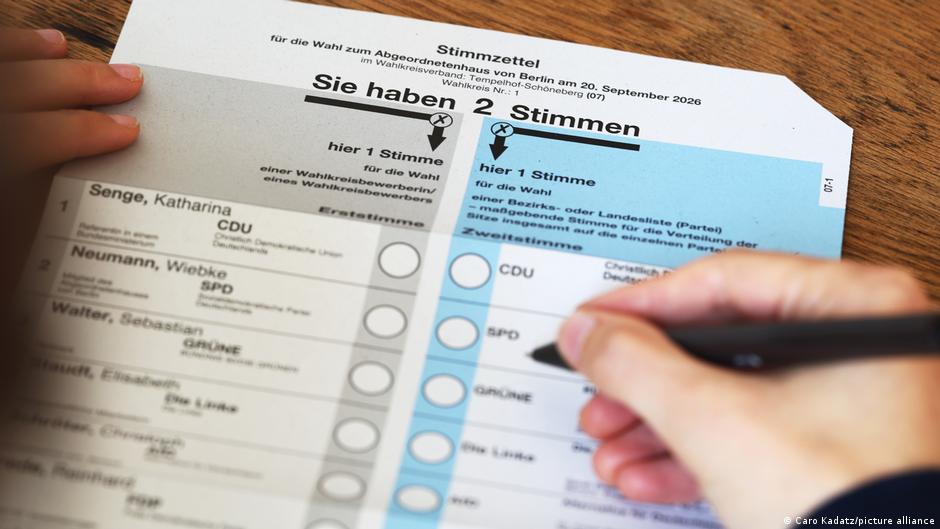
A video circulating ahead of Berlin’s September 20 state and district elections falsely claims to show a man opening postal-voting envelopes and destroying ballots marked for the Alternative for Germany, or AfD, according to DW Fact Check. The footage was shared with captions presenting it as evidence of election fraud.
DW reviewed more than a dozen posts carrying the video. One post had about 327,000 views when it was examined on September 18, while more than 15 posts together had accumulated over 3.2 million views. DW said the scale of the apparent reach should not automatically be taken as evidence of broad, organic public discussion.
Berlin’s state returning officer, Stephan Bröchler, told DW that the documents shown were not authentic Berlin election papers. He said the envelopes did not match those used for the election and that their method of sealing appeared suspicious. The background bins also bore a version of Berlin’s bear emblem that he said was not used by the city’s election authorities.
The footage shows a red envelope containing a white envelope and a grey-and-blue ballot paper for the Berlin House of Representatives. But, according to Berlin’s official postal-voting guidelines, voters receive a signed voter declaration, two envelopes and ballot papers for both the state and district elections. The signed declaration is absent from the video; without it, a postal ballot would be invalid. DW also noted that the footage did not clearly establish whether a second ballot paper was missing.
Bröchler concluded that actual Berlin election documents could be ruled out and said the video was intended to discredit postal voting. DW reported that many of the accounts sharing the footage displayed at least one potentially suspicious characteristic, such as rapid follower growth, repeated username changes or little evidence of ordinary engagement.
One account had previously been linked by the Lithuania-based research group Debunk to the so-called “Sprinter” network, which researchers described as showing signs of coordinated and inauthentic activity. DW stressed that such indicators alone do not prove coordination or artificial engagement. Researcher Julia Smirnova of CeMAS told DW that the video’s similarities to earlier false election claims and its dissemination pattern made it highly likely to be part of the Storm-1516 influence operation, which German authorities and researchers have attributed to Russia.