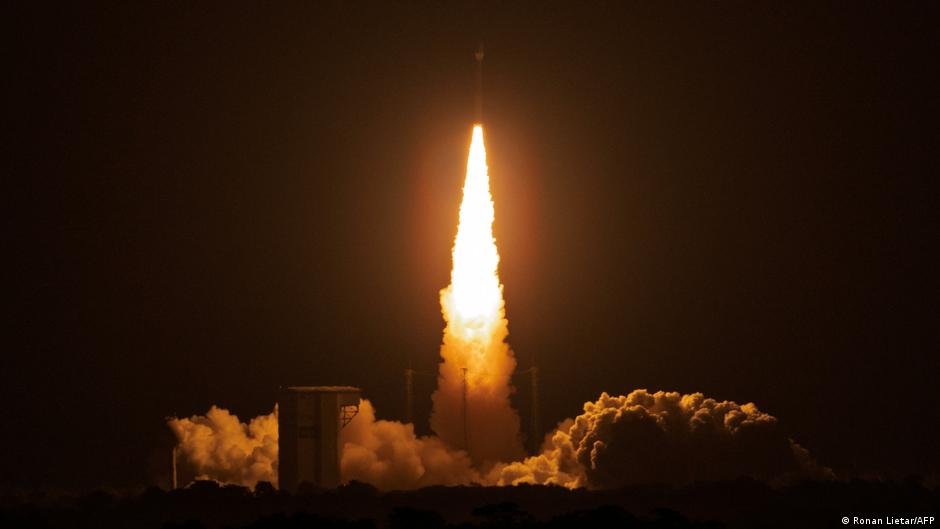
The European Space Agency has launched two satellites intended to strengthen monitoring of extreme weather and other effects associated with climate change, according to German broadcaster DW. The spacecraft, named Flex and Sentinel-3C, were carried into orbit aboard a Vega-C rocket from the Kourou space center in French Guiana.
The rocket lifted off at 10:21 p.m. Monday local time, or 0121 GMT Tuesday, and both satellites reached sun-synchronous orbit within two hours, DW reported. The missions are designed to provide researchers with more detailed observations of vegetation, oceans and land.
Flex, short for Fluorescence Explorer, will focus on plant life. It will detect the very faint fluorescence emitted by plants during photosynthesis, a signal that indicates how effectively vegetation converts sunlight and carbon dioxide into energy. ESA said the resulting measurements will help scientists evaluate plant health, ecosystem productivity and the effects of environmental stress and climate change.
The €350 million mission is planned to operate for three years. Flex will circle Earth 14 times a day and revisit specific locations every 27 days, according to DW.
Sentinel-3C will collect information about the marine environment, including temperature, wave height and ocean currents. It will also observe land use and land cover, with the stated aim of helping optimize agricultural yields and reduce the risk of food crises. The satellite is part of Copernicus, the Earth-observation component of the European Union’s space program.
Simonetta Cheli, ESA’s director of Earth Observation Programmes, described the missions as essential tools for understanding the climate change being experienced, DW reported.