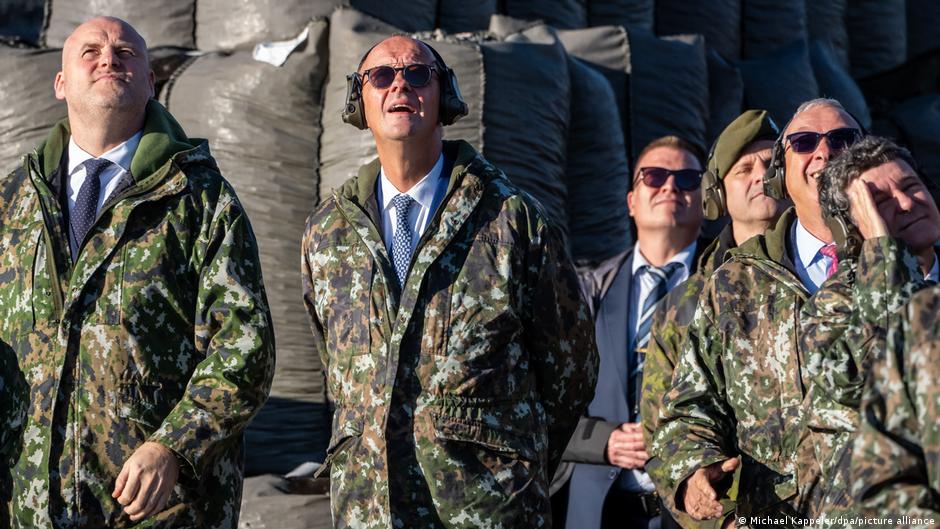
European leaders met in Rovaniemi, Finland, to discuss a new European Union approach to the Arctic, a region they say has become increasingly important for security, economic competition and climate policy. Finnish Prime Minister Petteri Orpo hosted the gathering near the Arctic Circle and said the security environment had changed fundamentally, making the High North a central arena of great-power competition.
Security concerns dominated the summit. EU foreign policy chief Kaja Kallas said Russia was reopening former Soviet military bases and conducting missile exercises in the region. German Chancellor Friedrich Merz described the Arctic as a geopolitical hotspot, saying Russia was expanding its military capabilities and using its regional presence for hybrid activities. Finland’s northern air force base monitors the skies along the country’s border with Russia, which became a NATO frontier after Finland and Sweden joined the alliance following Russia’s full-scale invasion of Ukraine.
The leaders also focused on the Arctic’s economic potential, particularly its critical natural resources. Merz said the region presented major opportunities, while Orpo called for strategic investment in infrastructure, dual-use transport networks, icebreaking capacity and technological innovation. The summit’s joint declaration supported stronger military mobility, cross-border connections, digital networks, satellite technology and critical infrastructure in Europe’s northern regions.
The European Commission plans to update its 2021 Arctic Strategy as early as October 2026. Timo Koivurova of the Arctic Centre at the University of Lapland said Russia’s current war effort was consuming military capacity, but argued that Moscow could invest more heavily in its northern regions after the war. He also said proposals associated with US President Donald Trump concerning Canada and Greenland had placed additional strain on cooperation among Western Arctic states.
Climate change is further transforming the region. Koivurova said the Arctic is warming at roughly four times the global average and that retreating sea ice is creating potential new shipping routes and shortening distances between major trading centers. He said climate policy had also become a source of tension, including within the Arctic Council, where he argued that the United States was resisting references to climate change. Arctic observer Markku Heikkilä said the region was gradually dividing into three parts, with Russia, Western countries and a changing US position forming increasingly distinct groupings.