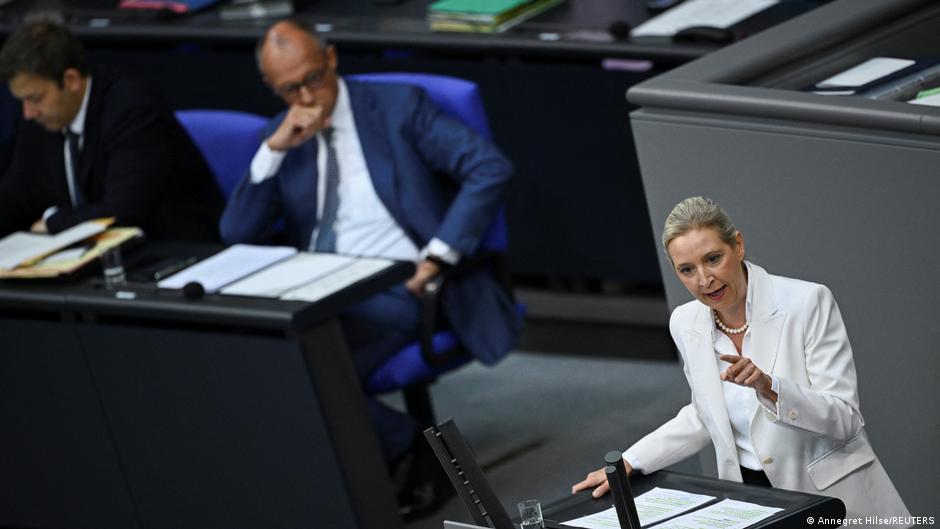
German Chancellor Friedrich Merz has rejected calls from the Alternative for Germany (AfD) to change Berlin’s policy on Ukraine and Russia, saying Germany will continue supporting Ukraine’s defence. Speaking in the Bundestag on September 9, Merz said Ukraine was also defending Germany’s freedom and argued that the government’s position retained majority support in parliament and among the population.
AfD co-leader Alice Weidel urged Merz to support peace negotiations, referring to US President Donald Trump’s stated willingness to seek talks involving concessions to Russia. Weidel also called for the resumption of cheap natural-gas supplies from Russia. During the debate, AfD lawmaker Jürgen Koegel praised Russian President Vladimir Putin and said he did not pose a war threat to NATO. The AfD has also alleged that Ukraine was responsible for the 2022 Nord Stream pipeline explosions, although the source text says a Ukrainian sabotage team is suspected of involvement.
The party’s position gained greater attention after it won almost 44% of the vote in Saxony-Anhalt’s September 6 state election. When the AfD’s result is combined with those of the Left Party and the Sahra Wagenknecht Alliance, about 60% of voters supported parties described in the source as sceptical of or opposed to aid for Ukraine. A survey cited by DW found that concerns about peace in Europe were among voters’ most important issues.
Public opinion also shows a marked east-west divide. An ARD Deutschlandtrend survey found that 54% of eastern Germans believed military assistance to Ukraine had gone too far, compared with 39% in western Germany. Across the country, that view has risen to 42%. Political scientist Johannes Varwick said the eastern response should not automatically be labelled pro-Russian, arguing that it reflected a preference for diplomacy rather than more weapons.
Another political scientist, Sven Leunig, told DW that eastern voters’ attitudes were driven more by fear of being drawn into the conflict than by outright rejection of aid. The survey also found that 56% of Germans felt strongly or very strongly threatened by Russia, while eastern Germans and AfD voters felt less threatened. Merz continues to defend the existing policy, but Leunig said a sustained decline in public support could eventually force the government to respond. Varwick called for a political strategy alongside support for Ukraine, warning against an open-ended war of attrition.