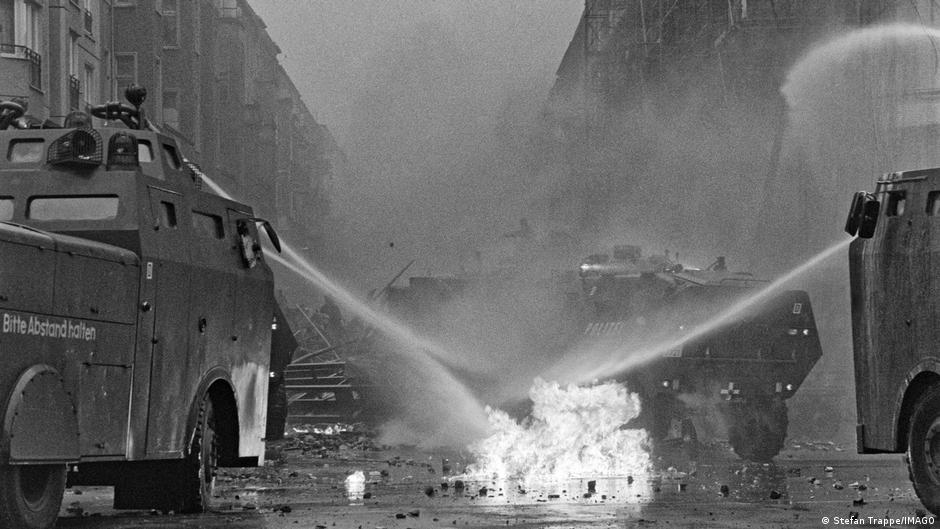
Berlin’s image as a politically unruly city has roots reaching back to the 19th century. DW’s account points to the Tailors’ Revolution of 1830, the barricades of 1848 and the rapid growth of an industrial working class as key moments in the development of the city’s radical political culture. When Joseph Goebbels became the Nazi Party’s Berlin district leader in 1926, he described the capital as “the reddest city in Europe besides Moscow.”
Industrial expansion in the 1870s and 1880s brought major mechanical, railway and clothing industries to Berlin. According to historian Axel Weipert, cited by DW, the growing working-class population helped move the city’s politics away from an elite bourgeois tradition and toward greater participation by ordinary people. The labor movement became more radical during Otto von Bismarck’s repression of socialist organizations, newspapers, public meetings and independent unions. After those laws were repealed in 1890, Marxist ideas helped turn socialism into what Weipert calls a “genuine mass movement.”
The First World War deepened divisions on the left. Although the Social Democratic Party and trade unions initially supported the war effort, Berlin became a center of mass opposition from 1916 onward. Karl Liebknecht, Rosa Luxemburg and other radicals organized the Spartacus League, while the Revolutionary Stewards linked anti-war activism to factory workers and unions. Around half a million Berlin workers joined the January Strike of 1918 amid food shortages, economic collapse and war fatigue. The uprising helped create the conditions for the Kaiser’s overthrow in Berlin later that year.
The Spartacist Uprising of 1919 sought to replace Germany’s provisional government with a workers’ council republic. Its suppression fractured the left, and Liebknecht and Luxemburg were killed by members of right-wing paramilitary forces. During the Weimar period, Berlin’s working-class neighborhoods remained centers of radical politics. DW reports that more than 30 people died in “Bloody May” in 1929, when police fired on banned May Day demonstrations, including in Wedding and Neukölln.
The Great Depression weakened the SPD as unemployment severed many workers’ ties to factories and unions. Historian Pamela Swett, also cited by DW, says unemployed men sought new forms of belonging and self-respect; some joined the Communist Party, while others entered Nazi paramilitary groups. After 1933, labor leaders were killed or exiled. Following the Second World War, division, deindustrialization and the Cold War reshaped Berlin’s left: student protests at the Free University intensified in the 1960s, and a housing shortage later helped produce a squatting movement involving students, apprentices, workers and migrant families.