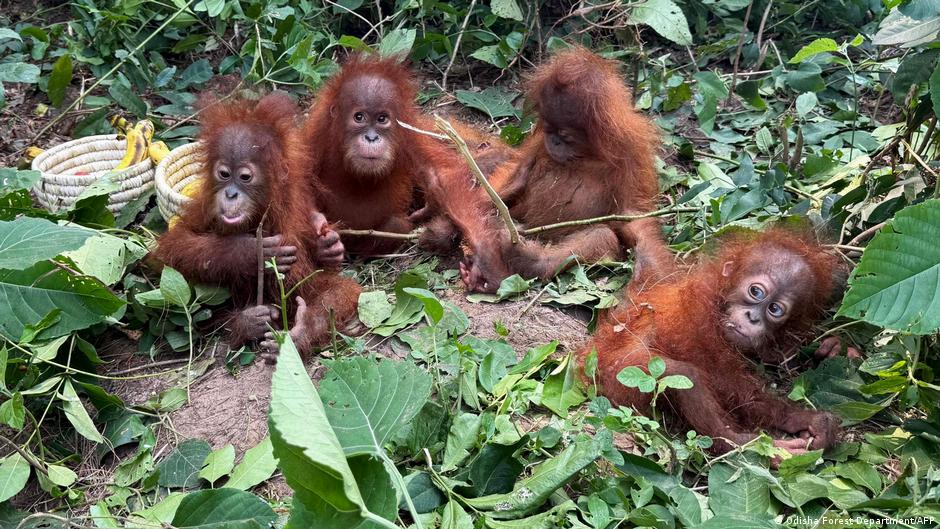
Rangers found five infant orangutans in a forest in Balasore district, in India’s eastern Odisha state, last week. The species is native only to Sumatra and Borneo, and Odisha authorities have asked the Wildlife Crime Control Bureau to investigate how the animals reached the area.
Indonesia’s Forestry Ministry has asked India to establish the orangutans’ origin and return them if they came from their natural habitat abroad. Odisha Forest and Environment Minister Ganesh Ram Singh Khuntia said the animals were not native to India and that authorities suspected they may have been released in the forest by an international wildlife-smuggling network.
The case has renewed scrutiny of India’s role in the illegal trade in exotic animals. DW cited a series of recent seizures, including 40 animals arriving in Bengaluru from Kuala Lumpur in November 2024, 284 animals intercepted in four consignments from Bangkok in Mumbai in June 2025, and 20 animals seized from Bangkok passengers in Pune the following month. The animals included tortoises, gibbons, alligators, iguanas, snakes, parrots and rabbits.
According to figures from wildlife trade monitoring network TRAFFIC, authorities seized 7,272 individual animals—alive and dead—from passenger baggage in attempted smuggling between Thailand and India from January 2022 through May 2025. More than 80% of the interceptions occurred in India, with reptiles, birds and mammals among the animals involved. Conservation researcher Uttara Mendiratta told DW that the volume and range of species trafficked into India had changed sharply since about 2020.
Experts cited by DW said trafficking routes include air links from Thailand and Malaysia, as well as land routes from Myanmar and Bangladesh through northeastern India. They said demand for exotic pets, including through unregulated online marketplaces and social-media platforms, was helping drive the trade. Conservation filmmaker Trishala Ashok said authorities often respond to individual seizures rather than tracing suppliers, financiers and buyers, while urging that each seizure be treated as the start of a wider investigation.