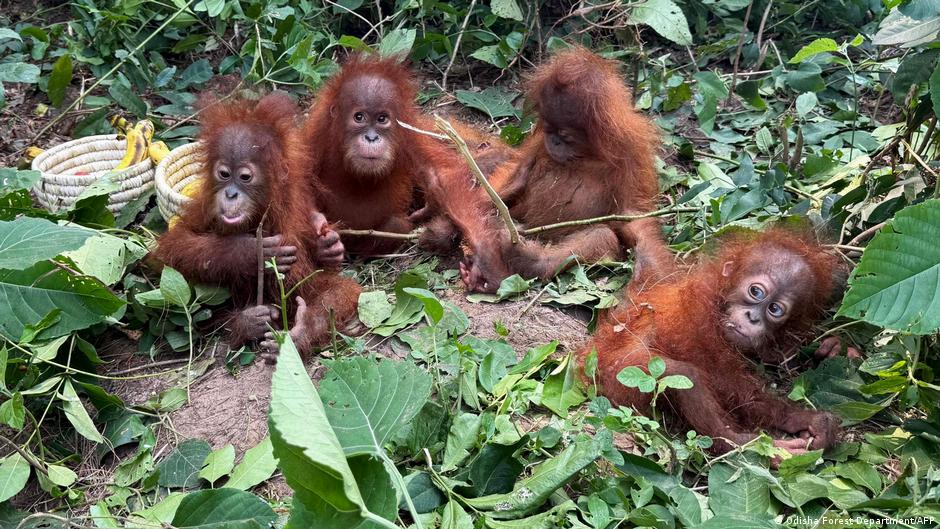
Five infant orangutans were found by forest rangers in Balasore district in India’s eastern Odisha state, raising questions about how the critically endangered apes reached a country where they do not naturally occur. Orangutans are native to parts of Indonesia and Borneo. Indonesia’s Forestry Ministry has asked India to establish their origin and return them if they came from abroad, according to DW.
The Odisha government has asked India’s Wildlife Crime Control Bureau to investigate. Odisha Forest and Environment Minister Ganesh Ram Singh Khuntia said officials suspected the animals may have been released in a forest by an international wildlife-smuggling operation. The source of the orangutans had not been established in the supplied material.
The case follows a series of seizures involving exotic animals entering India. Authorities in Bengaluru seized 40 animals arriving from Kuala Lumpur in November 2024, including giant tortoises, gibbons, American alligators and iguanas. Mumbai Customs seized 284 animals in four consignments from Bangkok in June 2025, while customs officials in Pune intercepted 20 animals from Bangkok the following month, including green tree pythons, parrots and Sumatran striped rabbits.
TRAFFIC figures cited by DW show that 7,272 individual animals, alive and dead, were seized from passenger baggage in attempted smuggling between Thailand and India from January 2022 to May 2025. More than 80% of those interceptions occurred in India. The animals included reptiles, birds and mammals, many apparently intended for the exotic-pet trade.
Conservation researcher Uttara Mendiratta told DW that hundreds of species and thousands of individual animals were being moved into India through air and land routes, with the volume changing sharply from around 2020. Tito Joseph of the Wildlife Protection Society of India said the trade had increased significantly since 2018, pointing to routes from Myanmar and Bangladesh as well as air links with Thailand and Malaysia.
Conservationists said seizures may reveal only part of the trade. Trishala Ashok told DW that enforcement agencies were often responding to individual cases rather than tracing suppliers, financiers and buyers. Other experts cited growing exotic-pet ownership and unregulated online marketplaces as factors sustaining demand, while warning that social media can help sellers display and market protected wildlife.