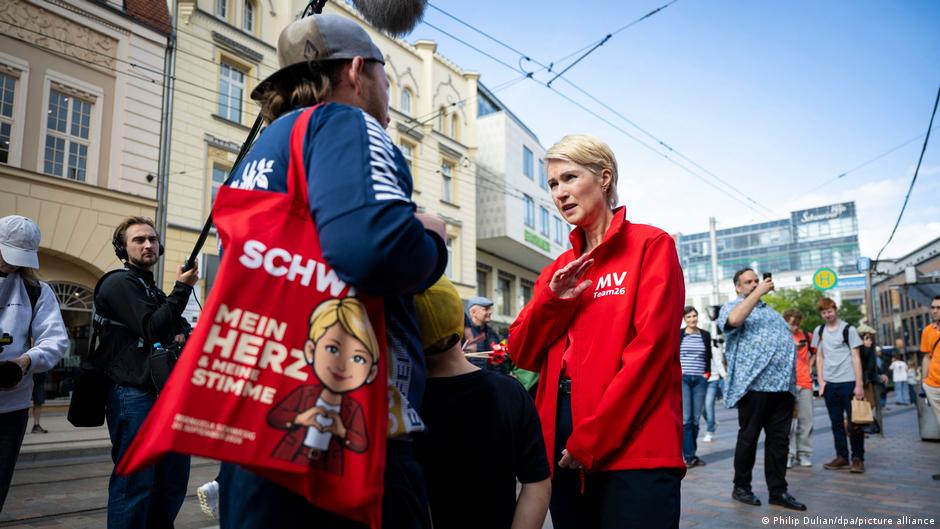
Mecklenburg-Western Pomerania’s Premier Manuela Schwesig is making the state election a personal contest between her Social Democratic Party and the far-right Alternative for Germany, according to DW. Her campaign posters show her face against a red background with the slogan “The Woman against Blue,” referring to the AfD’s party color.
The election is scheduled for September 20. DW says the AfD is polling at about 37%, while the SPD is close behind at 33%, having narrowed the gap in recent weeks. The conservative Christian Democratic Union is described as well behind the two leading parties and seeking to remain above the 5% threshold required to enter the state parliament.
The AfD’s campaign has prominently featured the term “remigration,” and business leaders in the northeastern state have warned that policies aimed at removing people with immigrant backgrounds would damage the economy. Business association president Lars Schwarz said international skilled workers and laborers were essential to the state’s economic future, particularly because Mecklenburg-Western Pomerania has an older, less densely populated population and faces pronounced demographic change.
At a business gathering, Schwesig recounted concerns raised during her campaign by employers who depend on workers with immigrant backgrounds. She also described a Moroccan employee who reportedly wanted to leave Germany after experiencing hostile behavior in public. Schwesig told DW that an AfD victory would harm the economy and social cohesion, adding that its “hate and incitement” was contributing to a more violent climate.
Schwesig, 52, has governed the Baltic coastal state since 2017. DW reports that she has improved the SPD’s position partly through direct engagement with voters and by sharply separating herself from the federal government, where the SPD governs in coalition with the CDU/CSU under Chancellor Friedrich Merz. She has criticized the coalition’s planned social-welfare reforms and demanded a different political course after an AfD victory in Saxony-Anhalt.
Her renewed popularity has also prompted speculation within the SPD about a possible national leadership role. DW says the federal party’s support has fallen to 12%, while Schwesig’s standing in her state has recovered from a much weaker position in September 2025. The election will test whether her personalized campaign can prevent the AfD from becoming the strongest force in Mecklenburg-Western Pomerania.