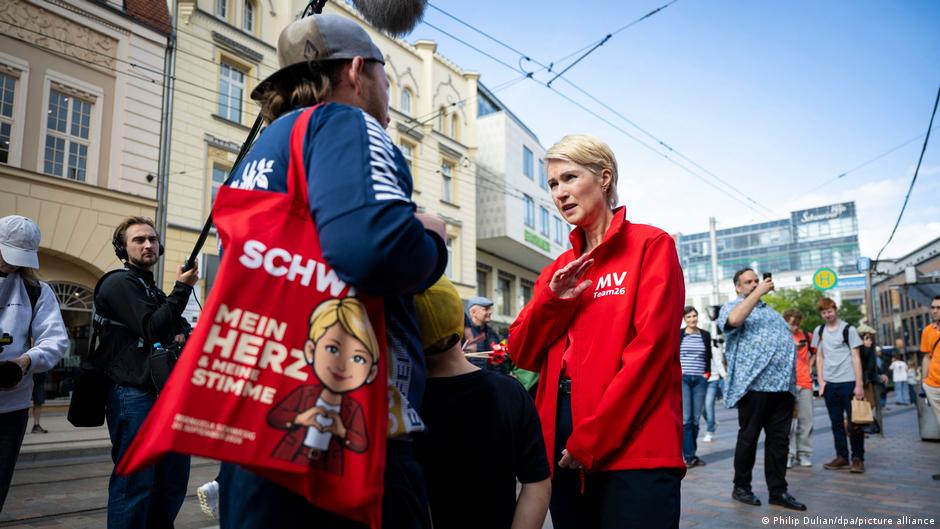
Mecklenburg-Western Pomerania’s Premier Manuela Schwesig is making the state’s September 20 election a personal contest between her Social Democratic Party and the far-right Alternative for Germany. Her campaign posters show her alone against a red background, using the slogan “The Woman Against Blue,” a reference to the AfD’s party color, according to DW.
The AfD was polling at about 37% shortly before the vote, while the SPD stood at 33% after narrowing a gap that had been considerably wider in September 2025. The conservative Christian Democratic Union, which governs Germany federally alongside the SPD, was described by DW as well behind the two leading parties and hoping to clear the 5% threshold needed to enter the state parliament.
Schwesig, who has governed the Baltic coastal state since 2017, says an AfD victory would damage both the economy and social cohesion. She told DW that the party’s language and alleged incitement were contributing to a more hostile environment and a renewed propensity for violence. She has urged voters who oppose that direction to support the SPD, although the party itself is largely absent from her campaign posters.
The state’s business community has also warned against the AfD’s focus on “remigration,” a term used in its campaign. Lars Schwarz, president of the state’s largest business association, said international workers were essential to Mecklenburg-Western Pomerania’s economic future. The state has an older and less densely distributed population than many parts of Germany and faces pronounced demographic pressures, DW reported.
At a business gathering near the Baltic coast, Schwesig described conversations with employers worried that immigrant staff might leave because of hostility. She recounted a baker’s concern for employees and a planning-company head whose Moroccan employee was considering departure after experiencing discriminatory reactions in public.
Schwesig’s recovery in the polls has coincided with her effort to maintain distance from the federal government and from the SPD’s national leadership. DW reported that she has criticized planned social-welfare reforms, including proposed changes to the retirement age for long-term contributors, and has called for a new political course in Berlin. Her renewed popularity has prompted speculation within the SPD about whether she could eventually take a leading role in the party.