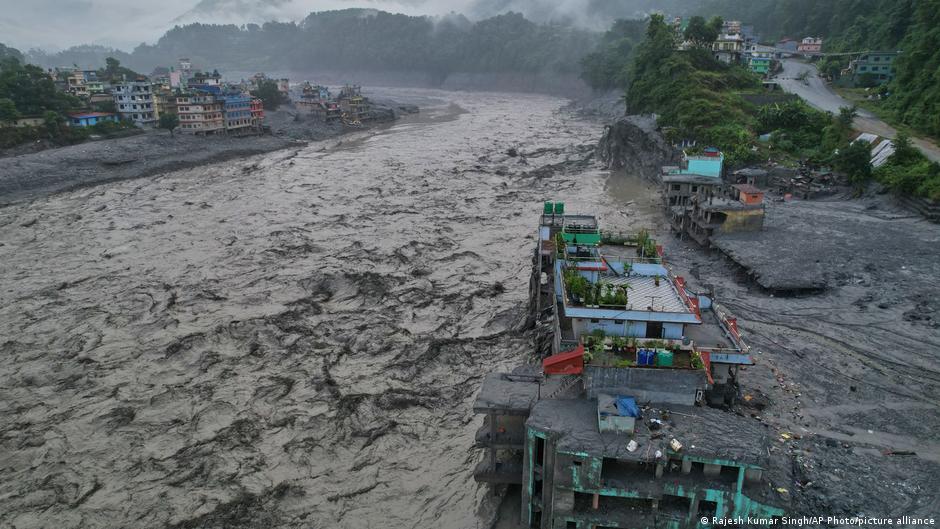
Nearly 1,400 people died and more than 5,000 remained missing after a mountain slope collapsed and flash floods swept through valleys in Nepal and Tibet, according to DW. The disaster was initially thought to have been caused by an earthquake, but researchers said a combination of long-term warming and geological instability set the conditions for the collapse.
The failure began on the north face of Langtang Lirung with a large rock avalanche that coincided with the collapse of part of a glacier. About 110 million cubic meters of rock and glacier ice plunged roughly 1,400 meters to the valley floor, gathering water, ice, sediment and other debris. The impact released energy comparable to a magnitude-5.2 earthquake and tore up buried glacier ice, adding as much as 30 million cubic meters of material to the flow.
The flood reached the Nepal-China border at Rasuwagadhi, about 20 kilometers downstream, in roughly seven minutes, traveling at an average speed of 170 kilometers per hour. It then continued for 200 kilometers in less than seven hours. Walter Immerzeel, a mountain hydrologist at Utrecht University, said several processes had acted together over years and decades, rather than one factor causing the failure.
Researchers with World Weather Attribution said climate change had reshaped the area over decades. DW reported that the nearby glacier retreated 75 meters between 1964 and 2000, then another 373 meters between 2010 and 2026. The loss of supporting ice, combined with thawing permafrost at elevations between 4,500 and 5,500 meters, left the rock walls increasingly unstable. Increased meltwater, unusually snowy conditions in October 2025 and a 2015 magnitude-7.8 earthquake may also have contributed.
The immediate conditions were exceptionally warm. July and August were the area's warmest on record, with climate change adding about 1.5 degrees Celsius to regional temperatures, while the maximum temperature on the day before the collapse was about 7 degrees above the reference average, according to the report.
Researchers said the event was difficult to detect because Nepal's warning systems focus on forecastable, rainfall-driven floods rather than rapidly developing chains of geological and glacial failures. The first mass text-message warning was sent about 38 minutes after the collapse, but the flood had already reached the border seven minutes after it began. Friederike Otto of Imperial College London said faster action to reduce fossil-fuel emissions was needed to limit the risk of similar disasters.