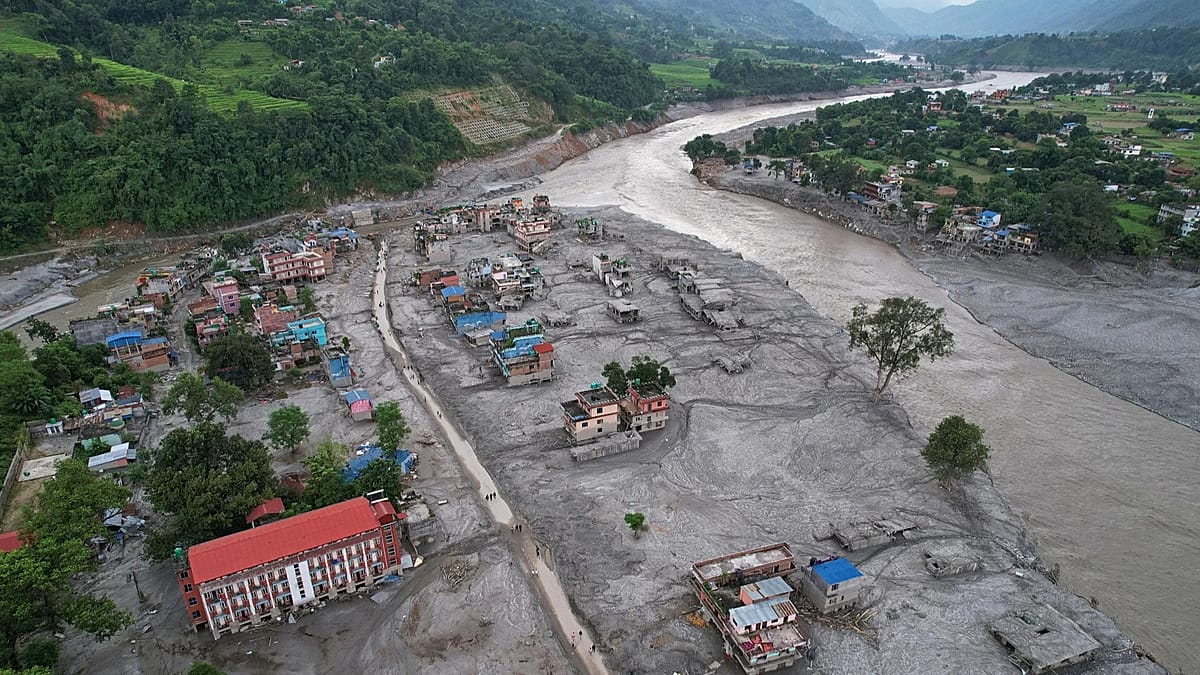
A World Weather Attribution report has identified climate change as a significant factor in the conditions preceding a deadly Himalayan disaster near Nepal’s border with China on 26 August. The report said long-term warming, glacier retreat and thawing mountain permafrost likely weakened the slope before it collapsed.
The collapse released a torrent of water, ice, boulders and sediment into communities along the Trishuli River corridor, killing more than 1,300 people and leaving more than 5,000 missing, according to the supplied source text. Researchers described the event as a compound crisis involving climate-related changes as well as possible geological instability.
Ben Clarke, a climate researcher at Imperial College London and a contributor to the report, said the disaster was not an extreme weather event but that climate change’s longer-term effects were visible. The report did not determine whether the collapse would have happened without warming caused by greenhouse-gas emissions, but concluded that rising temperatures intensified processes that made the slope less stable over decades.
One reported change was the upward movement of the freezing threshold by roughly 100 metres per decade. The shift has exposed higher-elevation rock to longer periods above freezing, contributing to permafrost thaw and cracks within ice that can weaken rock faces. Jakob Steiner, a University of Graz geoscientist who was not an author of the report, said monitoring around 5,000 metres showed that some ground and rock no longer remained frozen year-round.
The report also linked glacier retreat to instability. Glaciers in the region have been thinning by more than half a metre annually, while the Langtang Lirung glacier has retreated about half a kilometre since the 1990s, exposing previously ice-covered rock. Shrinking glaciers can remove pressure supporting adjoining rock walls and create additional meltwater, the report said.
The analysis noted that the weeks before the collapse were unusually warm, with July and August 2026 described as the warmest such months recorded locally. Friederike Otto, one of the report’s authors, said geological factors such as earthquakes may also weaken bedrock, but that the other destabilising processes were made worse by human-induced climate change.