Merz visits Kyiv as Russian strike hits bridge and Germany pledges aid
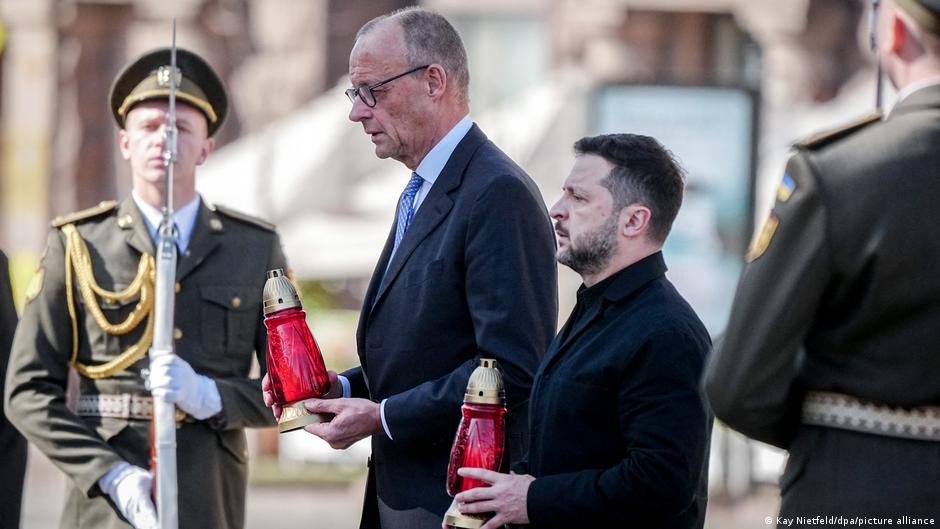
German Chancellor Friedrich Merz visited Kyiv as Russian attacks continued, including a strike that damaged the road surface of the Northern Bridge. Germany announced more than €1.3 billion in military and energy assistance, while Kyiv and Berlin outlined broader defence-industry cooperation. Ukrainian officials reported casualties from the wider drone campaign, though accounts differ on the figures.
German Chancellor Friedrich Merz visited Kyiv on Sunday as Russian attacks continued across the Ukrainian capital, including a strike that damaged the road surface of the Northern Bridge, and pledged more than €1.3 billion in military and energy support for Ukraine. Merz arrived by train with Economy Minister Katherina Reiche and German business leaders from companies including Siemens Energy, Hensoldt, Diehl Defense and Quantum Systems. Air-raid sirens sounded during the visit.
Kyiv mayor Vitali Klitschko said a Russian drone had hit the bridge, one of several crossings over the Dnipro River targeted in recent days. The South China Morning Post reported that the strike came soon after Merz’s arrival and that images posted on messaging channels appeared to show a missile hitting the structure. DW, citing Klitschko, reported damage to the road surface and said emergency services were sent to the scene.
The supplied reports do not establish the full extent of the damage or whether the bridge was rendered unusable. Speaking beside the damaged Academy of Sciences building, where DW said at least two people were killed in a drone strike the previous week, Merz urged Russian President Vladimir Putin to halt attacks on civilians. He said Germany and its partners were ready to discuss ending the war, but that Russia’s attacks had to stop.
He also warned that if Russia was not stopped, its war machine could eventually turn against Europe. Ukrainian President Volodymyr Zelenskyy described the situation in Kyiv as terrible and said Ukraine must not be left alone. NDTV, citing Zelenskyy, reported that Sunday’s drone strikes killed one person and injured six.
That account did not specify locations or damage, while DW’s report focused on the bridge strike and earlier casualties. The differing figures and descriptions appear to refer to different time periods, and the reports provide no independent casualty assessment. Germany’s announced package is worth more than €1.3 billion, including €1 billion in military assistance and €350 million for energy repairs ahead of winter.
SCMP described the military element as more than US$1 billion and said German sources expected support involving combat drones, satellite technology and joint production of anti-jet drones. DW reported plans for thousands of interceptor drones and expanded production of long-range weapons capable of reaching targets more than 1,000 kilometres away. Zelenskyy said Ukraine and Germany had reached 15 agreements worth more than €8.5 billion, covering defence cooperation, procurement, production and joint projects.
Merz said cooperation would also strengthen German security by allowing the countries’ companies to develop technology together. The visit followed a warning from Russia’s Foreign Ministry that diplomats and other visitors should avoid Kyiv, particularly military and government sites. Moscow said its strikes were responses to what it called Ukrainian attacks on Russian civilian infrastructure.
The European Union’s ambassador to Ukraine said the delegation would remain. Merz said Ukraine was approaching a fifth winter of war as Russia intensified attacks on cities, homes and power facilities, while Germany prepared assistance for generators, transformers and grid repairs.
Vertrix News compared the attributed reports listed below and wrote this independent synthesis. Claims remain attributed where independent verification was unavailable.