Dodik ally leads Bosnia presidency race as nationalist bloc claims wider win
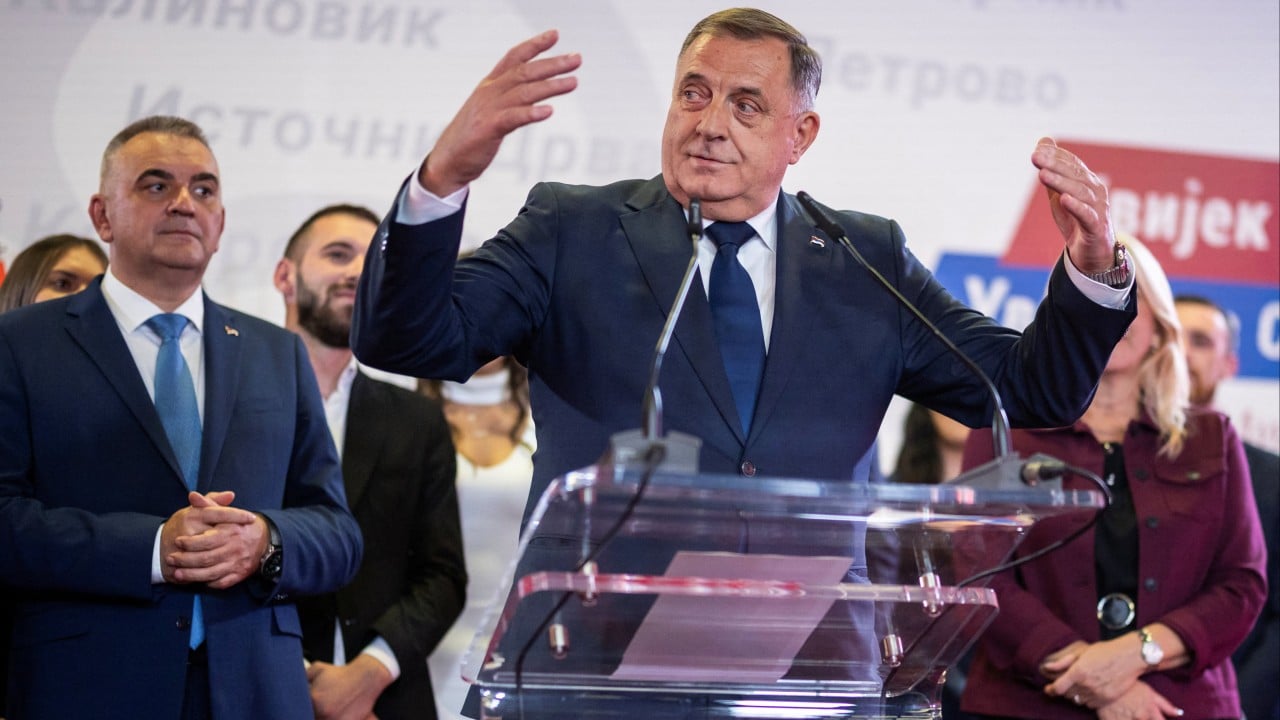
Bosnian Serb leader Milorad Dodik declared victory for his nationalist party after an election marked by ethnic divisions, economic concerns and debate over European Union membership. With most votes counted, his ally Zeljka Cvijanovic led the Serb presidency contest, while candidates for the Croat and Bosniak seats also claimed victory.
Bosnian Serb nationalist politician Milorad Dodik has declared victory for his party in Bosnia and Herzegovina’s election, despite being barred from holding public office and not appearing on the ballot. With nearly 90 per cent of votes counted, his ally Zeljka Cvijanovic of the Alliance of Independent Social Democrats had more than 55 per cent of the vote for the Serb seat on Bosnia’s three-member presidency. She led her nearest rival by about 30 percentage points.
Dodik also said his party would win a large majority in the assembly of Republika Srpska, the Serb-dominated entity within Bosnia and Herzegovina. He credited US President Donald Trump and Russian President Vladimir Putin for what he described as the election victory, and said his political approach would not change. The election was held amid longstanding tensions among Bosnia’s Bosniaks, Serbs and Croats.
The country’s complicated political system was created under the 1995 peace agreement that ended the war, but Dodik has repeatedly challenged the authority of national institutions and advocated the separation of Republika Srpska. With more than 94 per cent of votes counted, Darijana Filipovic of the Croatian Democratic Union of Bosnia and Herzegovina held a strong lead in the Croat presidency race. Incumbent Bosniak member Denis Becirovic was ahead of Bakir Izetbegovic by fewer than three percentage points.
Both candidates declared victory before the final count. The Central Election Commission said 1,432,269 votes had been cast, representing 42 per cent turnout, about eight percentage points lower than in 2022. The vote was the first in Bosnia to use electronic voter identification and ballot scanners, though technical problems delayed voting at some polling stations.
The election comes as ethnic divisions continue to obstruct Bosnia’s progress towards European Union membership. Analyst Dragan Bursac said Dodik remained influential despite the ban on holding office, describing him as still being in command of the political movement. Some polling stations affected by technical disruptions were allowed to remain open after the scheduled 7pm closing time.
Republika Srpska’s interior ministry said delays had occurred at 201 of the entity’s 1,957 polling stations.
This independently written report is based on information supplied by the named publisher. Vertrix News has not independently verified the source report.